
When the World Turns on Black Women: A Reflection on Power, Proximity, and the Fragility of Our Progress
When the World Turns on Black Women: A Reflection on Power, Proximity, and the Fragility of Our Progress
There are moments in a leader’s life when the honor bestowed upon you feels so right—so aligned with purpose—that you almost forget how dangerous it has always been to be a Black Woman in America. For me, that moment came when Melanie Campbell asked me to serve as thefirst convenor of the Nation’s Capital Black Women’s Roundtable.
I remember the rush of excitement, the anticipation of learning from Melanie—President of the National Coalition on Black Civic Participation and a towering figure in civil rights. It was a world adjacent to mine, yet different: a shift from my usual fights for economic power, placemaking, and liberation through ownership, toward the sacred responsibility of stewarding Black Women’s civic influence in the capital of the free world.
Back then, Black Women were riding what felt like an all-time high. I lived in a city led by a Black Woman Mayor. A Black Woman Police Chief. A Black Woman Congresswoman—our Warrior on the Hill, Eleanor Holmes Norton. And all around me were scores of distinguished Black Women leaders, locally and federally, shaping systems, moving resources, and rewriting what power looks like.
Dynamic Black Women were pulling mein—and more importantly, pulling meoutof the shadows. Across the border in Prince George’s County, a Black Woman County Executive was making a historic run for the U.S. Senate. And at the national level, the icing on the cake:a Black Woman was Vice President of the United States.
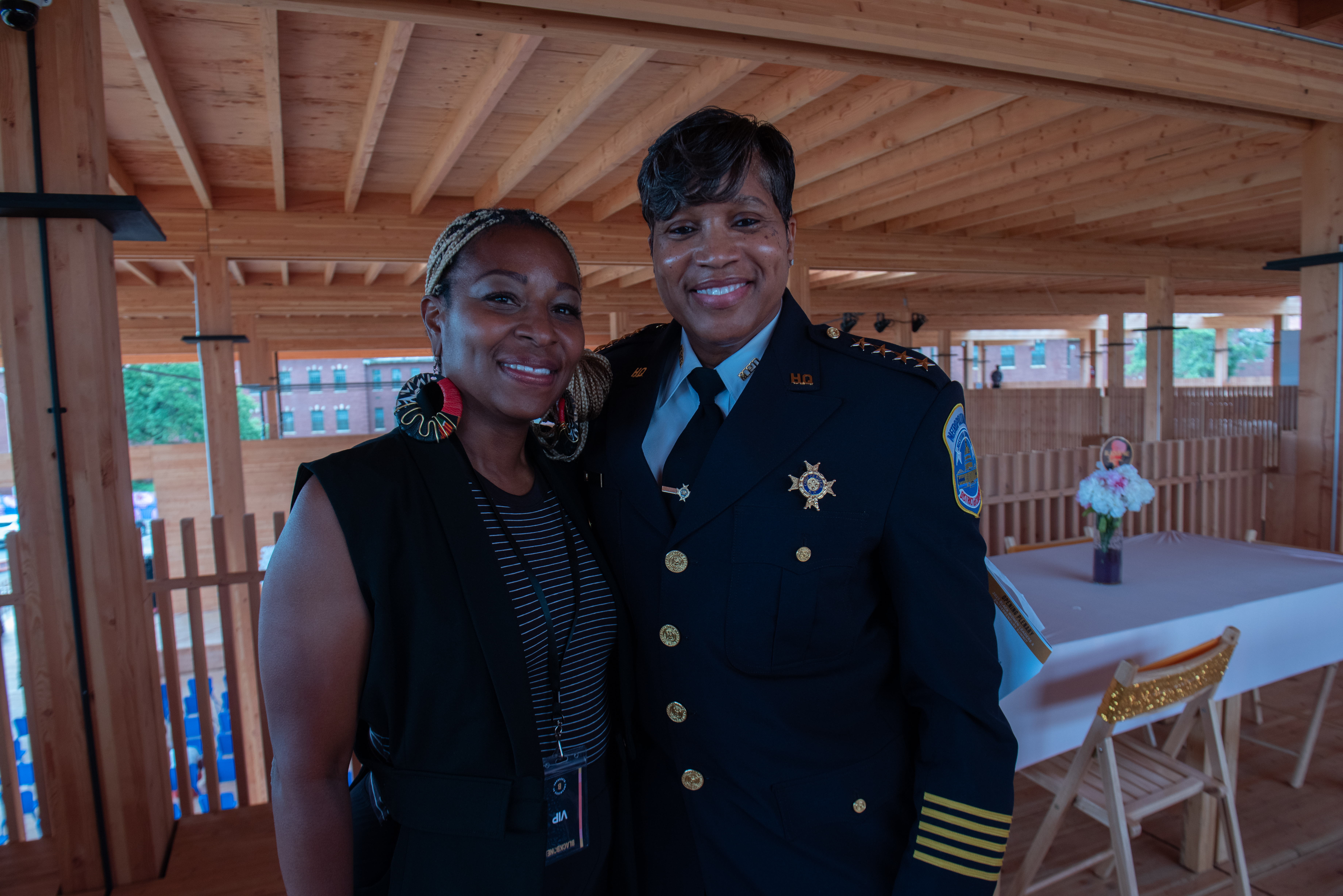
And in 2023, nearly all of them walked the grounds ofSycamore & Oak, the first-of-its-kind, largest free-standing mass timber structure in Washington, D.C. I had the profound opportunity to shepherd this project—a physical manifestation of what Black ingenuity, economic imagination, and community-rooted leadership can produce when the world steps aside long enough for our magic to breathe.
By the next summer, that same Black Woman Vice President was running for President of the United States. After helping solidify Angela Alsobrooks’ rightful place in the history books, I boarded a plane for Chicago to help cement Kamala Harris’ win. There was electricity in the air. The world felt like it was tilting, finally, toward justice, toward possibility, toward Black Women.
And with so much happening around us, it was tempting to believe, even for a moment, that everything wascopacetic, as my grandfather would say.
It felt so right that I allowed myself to forget, briefly, just how tenuous the world still is for Black Women.
But today, I was reminded yet again.
You know the story by now.
The Mayor has announced she will not seek re-election, plunging the District into political uncertainty. Congresswoman Norton is facing the most serious opposition of her storied career.
Senator Alsobrooks is doing what Black Women always do—fighting uphill in a Congress controlled by MAGA Republicans who orchestrated the longest government shutdown, unraveled the FBI headquarters relocation, and subjected her to a parade of underqualified appointees. All while she must remain calm, measured, composed—lest she be framed as the “angry, emotional” Black Woman, despite having at least 212 reasons to be both angry and emotional.
Anita Bonds, one of only three Black Women on the Council, has chosen not to run again.
And yesterday, our Police Chief resigned.
Another Black Woman casualty of a system designed—intentionally or not—tobreak us, toundermine us, todiscard us.
Another example of our hard work, our dedication, our sacrifice being unappreciated, disrespected, and undervalued.
Today, I am worried about our city.
Not for the reasons people will speculate about on the news or in political circles. I am worried because we still have not figured out how tohonor the toiling, the nurturing, the caretaking, and the nation-building labor of Black Women.
We have not figured out how to protect her.
We have not learned how to stop the enemy—external and internal—from using us to harm us.
So yes, today I am sad.
Not because Chief Pamela Smith will struggle to find what’s next—I hear lemonade on the back porch is delightful.
I am sad because we lost a gem.
We lost a Police Chief who led with the nurturing care Black Women have always brought to every table—from tending enslavers’ children to raising the motherless and fatherless ones in our communities.
We lost a Chief with a true heart for this city.
We lost a Chief who deserved both protectionandaccountability.
A Chief who should not have been left standing alone.
And yet, even in my sadness, I remain hopeful.
I am hopeful that little girls across this city miss this lesson entirely—that they grow up never learning the dangerous message that a Black Woman can give everything she has and still be cast aside. I hope they grow up knowing that they can do anything, build anything, lead anywhere, and be supported while doing so.
I want them to know that their magic can build families, sustain generations, protect communities, preserve whole nations—and, when necessary, walk away with their heads held high and say, without apology:
Enough. I’m out. (I had another adverb, but..)
Because Black Woman magic has always been both creation and boundary, love and fire, endurance and refusal.
And despite the attacks, despite the losses, despite the fragility of our moment, I still believe in us.
I still believe in our city.
I still believe in our collective power to shift what justice looks like.
But today, I needed to name the truth:
We are not okay.
And until Black Women are protected, the Nation’s Capital never will be.