
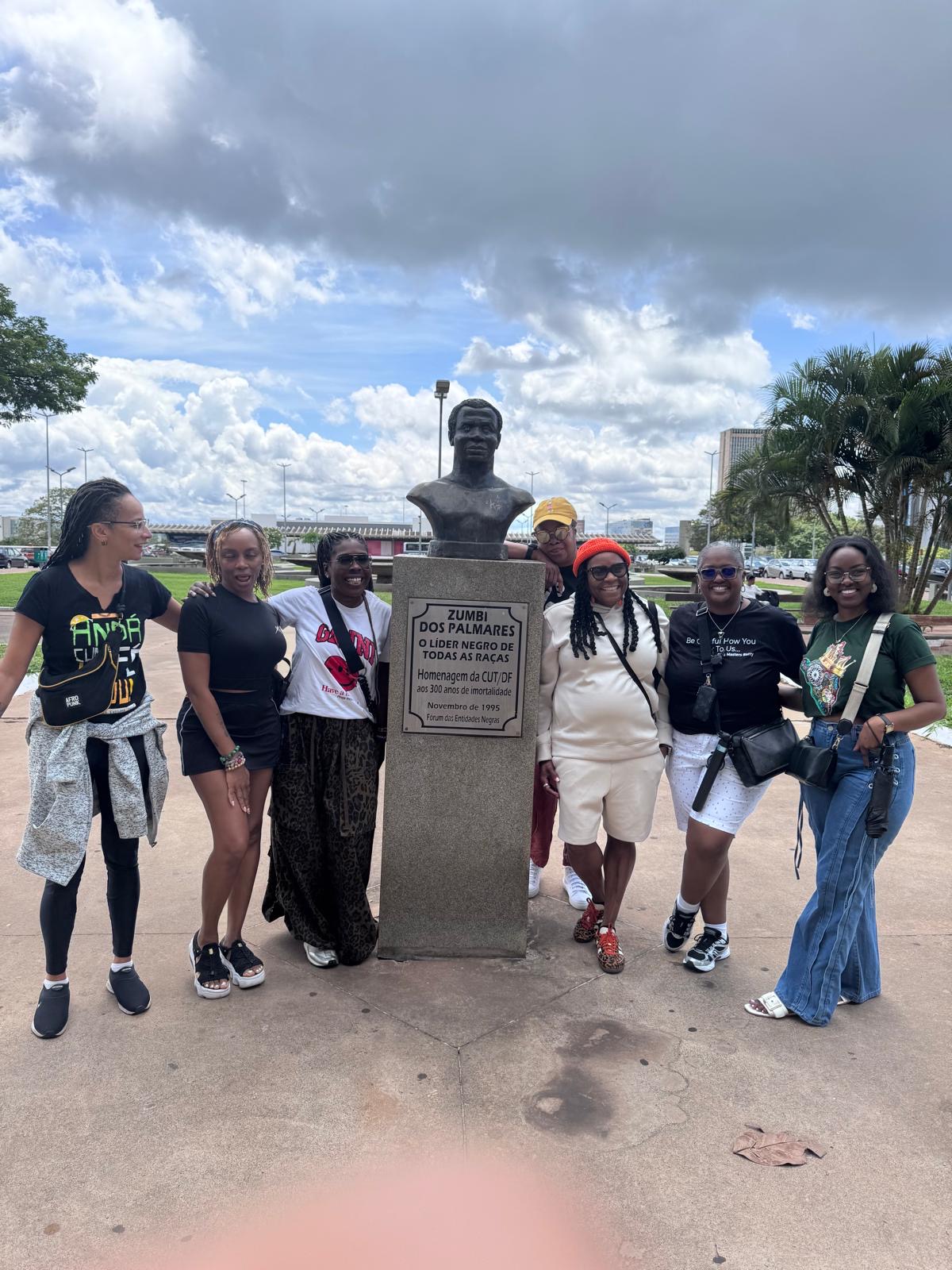
What It Feels Like to Be Part of This Delegation…
What It Feels Like to Be Part of This Delegation…
There is a particular rhythm to being part of a delegation of Black women. It’s part spiritual alignment, part cultural intuition, part unspoken sisterhood. You feel it the moment the day begins — even when the morning starts earlier than you’d like.
Yesterday was our first full day of organized activity, and our schedule required us to prepare to leave our hotel before 9 a.m. So I rose with the still-dark Brasília sky, got dressed, and made my way downstairs to join the group. Sleepy or not,I woke up rooted in purpose, knowing the day ahead would hold history, culture, and the weight of a movement bigger than any one of us.
Brasília Negra Tour — Day Begins
Before we began the day, we met our tour guide — a woman deeply rooted in Brasília’s untold stories. She greeted us with the warmth of someone who carries history in her spirit, and within minutes she made it clear that we would not be getting the sanitized version of Brasília’s past. Instead, she offered us theBlack perspective— the fingerprints of black architecture, design and labor on this planned city - the one rarely written in textbooks, often erased in public memory, yet undeniably foundational to this city. It was the history of the builders, the displaced, the culture-bearers, and the people who shaped Brasília long before it became the “planned city” the world admires.
Orixás Square — Where Ancestry Stands Unbroken
Our next stop took us to Orixás Square, a site that embodies spiritual resistance and cultural survival.
Here, we learned how enslaved Africans preserved their Pan-African faith traditions by cloaking them in Catholic imagery — a spiritual sleight of hand that allowed them to maintain connection to their deities while avoiding punishment (and even death) under Portuguese rule.
Standing there, I felt the ingenuity of our ancestors. It reminded me — yet again — that:
Black people will always find a way to remain whole, even when the world conspires to fracture us.
Lunch — Conversations in Diaspora
After leaving Orixás Square, we sat down for lunch — a moment that blended nourishment with the kind of conversation only a table full of Black women can spark.
Topics ranged from politics to personal histories, and inevitably, we found ourselves comparing President Lula of Brazil with Mayor Marion Barry of Washington, D.C. — two figures whose legacies are complicated yet deeply beloved by the people who saw their leadership as transformational despite their flaws.
Leadership isn’t about perfection.
It’s about being shaped — and sometimes resurrected — by the communities you serve.
Brazil’s National Congress — The Shell Up, Shell Down
After lunch, we visited Brazil’s iconic National Congress complex, designed by the legendary Oscar Niemeyer.
The twin domes — the “one shell up, one shell down” structures — hold powerful symbolism:
•Concave bowl (shell facing upward)
Chamber of Deputies →receiving the demands of the people
•Convex dome (shell facing downward)
Federal Senate →calm reflection and deliberation
Niemeyer’s architecture uses geometry to tell political truth. And as I stood there, taking in the modernist expanse, I couldn’t help but reflect on how Black women continuously occupy both roles — receivers of community needs and deliberate architects of solutions.
Evening Welcome Reception — Hosted by B-WEL
We closed our day with a powerful welcome reception hosted our hostess organizationB-WEL (Black Women’s Executive Leadership)— and it was there that the emotional and political weight of this journey crystallized.
Our keynote speaker, Maria Louisa, a senior organizer who has been active in Brazil’s Black People’s Movement since the 1970s, gave us a history lesson you won’t find in brochures or glossy government narratives.
She spoke plainly, urgently, truthfully:
State Violence and Invisible Resistance
• As a young student, she studied resistance movements inSouth Africaand in theU.S. civil rights struggleof the 1960s.
• She described howpolice fabricated drug storiesto justify killing young Black people — a practice hauntingly familiar to our own communities back home.
• She recounted the horrors of of state sanctioned murder in 2025 where120 people were killed in Rio, many with their throats slit, their bodies displayed on city streets as warnings.
The 2015 March — For Well-Living, For Survival
She shared the origins of the 2015March for the Well-Being of Black Women, emphasizing that the movement was — and still is — about protecting Black women and their children.
But the marchers faced:
•far-right militias, heavily armed and out of uniform
• a media blackout
•no protection for ordinary marchers despite threats
• violent narratives created to silence Black voices
Still, they marched.
She spoke of Brazil’s obsession with “whitening”:
• families where siblings identify as different races
• Afro-descendant people denying their Blackness
• post-COVID treatment where migrants of certain backgrounds were welcomed while Black asylum-seekers and black people in their own land were rejected.
And then she said:
“Black women speak the truth first!” They spoke of the atrocities in the movement, they spoke in 2015 when the 1st Black Woman’s March took place and they will speak loud and clear tomorrow.
A Charge for Tomorrow — What the March Means
She warned that:
• many Black women arriving for this year’s march will be coming from the periphery,
• from communities without access to hotels like ours,
• relying on buses sponsored by politicians to even reach the city.
And she challenged all of us:
“We must elect Black leaders who seek solutions —
not leaders who simply say ‘Jesus will fix it.’”
She closed with the question:
“What does the March mean to you?”
And in that question, she handed every woman in the room a responsibility — not just to bear witness, but to return home and act.
We ended the night over authentic Brazilian cuisine — fried cassava, stews rich with African influence, and the exhale that comes from a long, meaningful day.
So, I close this blog by answering Maria Louisa’s question along with the one that I asked myself today - What does it feel like to be part of the @HumanityUnited delegation?
It feels like:
• carrying history and building future,
• learning and unlearning in real time,
• being held and being challenged,
• standing inside a global movement of Black women who are clear, courageous, and unafraid to speak truth first.
Today, we march.
But last night, we honored the women who built this path and the ones who will walk it after us.