MARCH DAY Macha de Mulheres Negras
MARCH DAY Macha de Mulheres Negras
Sleep never truly found me last night.
Somewhere between anticipation and purpose, my spirit was already marching. Even in the moments when I drifted into slumber, the rain tapping against my window kept me aware—reminding me that today would be powerful, historic, transformative…and wet.
The rain felt like a blessing. A cleansing.
As if the ancestors were preparing the ground beneath our feet.
Our gathering time was pushed back to give the storm room to move on and the sun to shine granting us those precious morning minutes Black women rarely get—time to breathe, time to prepare, time to gather ourselves and our intentions before stepping into a moment none of us would forget.
But nothing prepared me for the sight that met us once we stepped outside.
Brasília was electric.
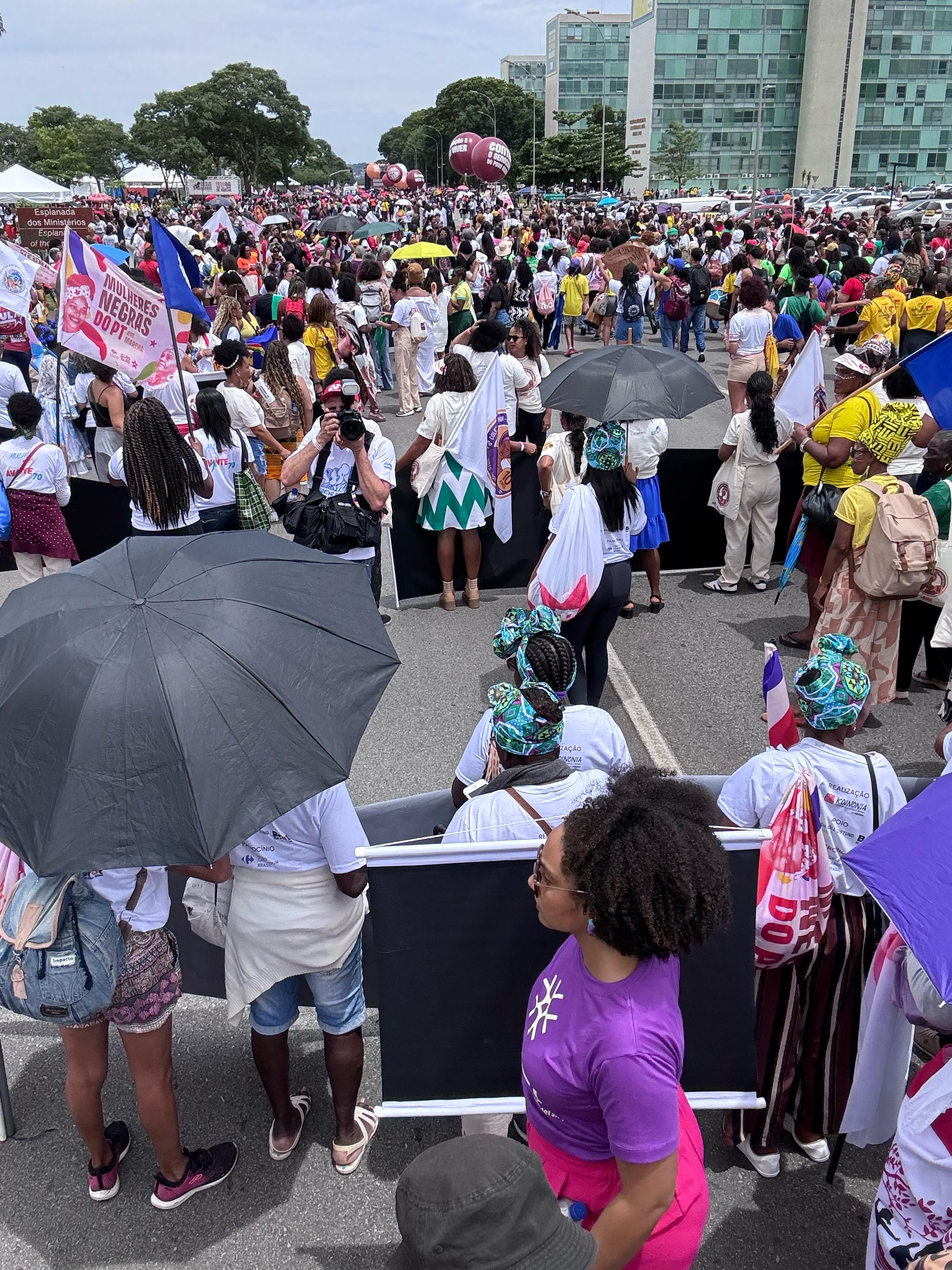
A moving river of Black women—thousands strong—flooded the avenues on foot and by buses. The throngs White shirts, purple shirts, tote bags, flags, drums, umbrellas, braids, locs, natural curls, babies on hips, elders in yellow garments, activists, scholars, midwives, griãs, organizers, and everyday women who showed up to demand a better world.
And in that instant, I understood:
This is what global sistership looks like.
This is what global sistership feels like.
As we marched, I could feel two cities inside me- Washington, DC and Brasília- braided together by the shared heartbeat of Black women refusing to be invisible, refusing to give up on creating the world that we dream of.
Back home, my work with theBlack Women’s Roundtableis grounded in the fight for human rights—rights that show up as:
• Voting rights
• Civic participation
• Reproductive freedom
• Political representation
• Safety and dignity for Black families
Here in Brazil, women were chanting for Reparações (Reparations) and Bem Viver(Good Living).
Different language.
Same struggle.
Same vision.
Reparações echoes our call for repair.
Bem Viver mirrors our demand for communities where Black people thrive, not merely survive.
The fight is global.
And so is the sisterhood.
As I watched young Brazilian women march—strong, assured, whole—I immediately thought of the women in the Kiongozi Collective.
Women who are learning to trust:
their voice,
their brilliance,
their authority,
their inner knowing.
In the young Brazilian leaders, I saw the same fire I see in Kiongozi—proof that across continents, Black women are stepping into leadership with boldness and purpose.
What I felt today was confirmation:
Kiongozi is not just a DC project.
It is part of a global movement of women leading themselves—and their communities—forward.
As we approached the ministries, I saw mothers marching with their children, grandmothers marching with their grandchildren, educators marching with their students.
And it struck me deeply:
Education is liberation in any language.
In DC, our work throughCommunity College Preparatory Academycreates pathways for adult learners—many of them Black women—to rewrite their stories.
To pursue credentials, careers, and possibilities once denied.
ThroughProspering Places, our work is rooted in building healthier, safer, more prosperous communities—our own version ofBem Viver—where families have what they need to flourish.
The call for Reparações and Bem Viver is the call for:
safety
economic stability
healthcare
education
housing
opportunity
justice
Exactly the world we are fighting to build in Congress Heights and in District of Columbia as a whole.
Seeing it reflected back to me on the streets of Brasília was like looking into a mirror made of movement.
There was a moment when a massive Brazilian flag unfurled across the avenue—stretching wider than any banner I’ve ever carried. Hundreds of hands lifted it, and I watched women step underneath it with pride and reverence.
Behind it, the enormous purple and black banner of the Marcha das Mulheres Negras swayed above the crowd like a crown.
The drums shook the pavement.
The chants rose in Portuguese. (Saraya Criolo)
The air vibrated with power.
And all of us, Brazilian, American, Afro-Caribbean, African-born, were moving forward as one body.
In that moment, I felt the truth:
We were not just witnesses.
We were participants in a global chapter of Black women’s history.
This march confirmed what I’ve always known but felt even more deeply here:
Our work in DC is part of a global tapestry of Black women fighting for dignity, justice, and joy.
Whether the issue is voting rights in the U.S. or Reparações in Brazil…
maternal health in DC or state violence in Rio, leadership development through Kiongozi or youth organizing here…
pathways through CCPrep or pathways through Brazilian community schools…
The struggle is shared.
The hope is shared.
The healing is shared.
The future is shared.
And when Black women gather—across borders, across languages, across oceans, we shift the earth beneath us.
Today reminded me why I do this work.
Why I lead.
Why I fight.
Why I pour into community.
Why I invest in young women.
Why I believe in possibility.
Why I trust the power of collective action.
Because this is not just about DC.
Not just about Brasília.
Not just about the U.S. or Brazil.
This is a global movement for our lives.
And today, I marched inside of it.
Black women across the diaspora are building a better world—one march, one movement, one miracle at a time.
Enjoy the sights and sounds of the day!
Monica Ray