Ten Years of Art All Night: How Congress Heights Turned Culture Into Commerce, Community, and Legacy
Ten Years of Art All Night: How Congress Heights Turned Culture Into Commerce, Community, and Legacy
By Monica T. Ray
Ten years.
That is worth sitting with for a minute.
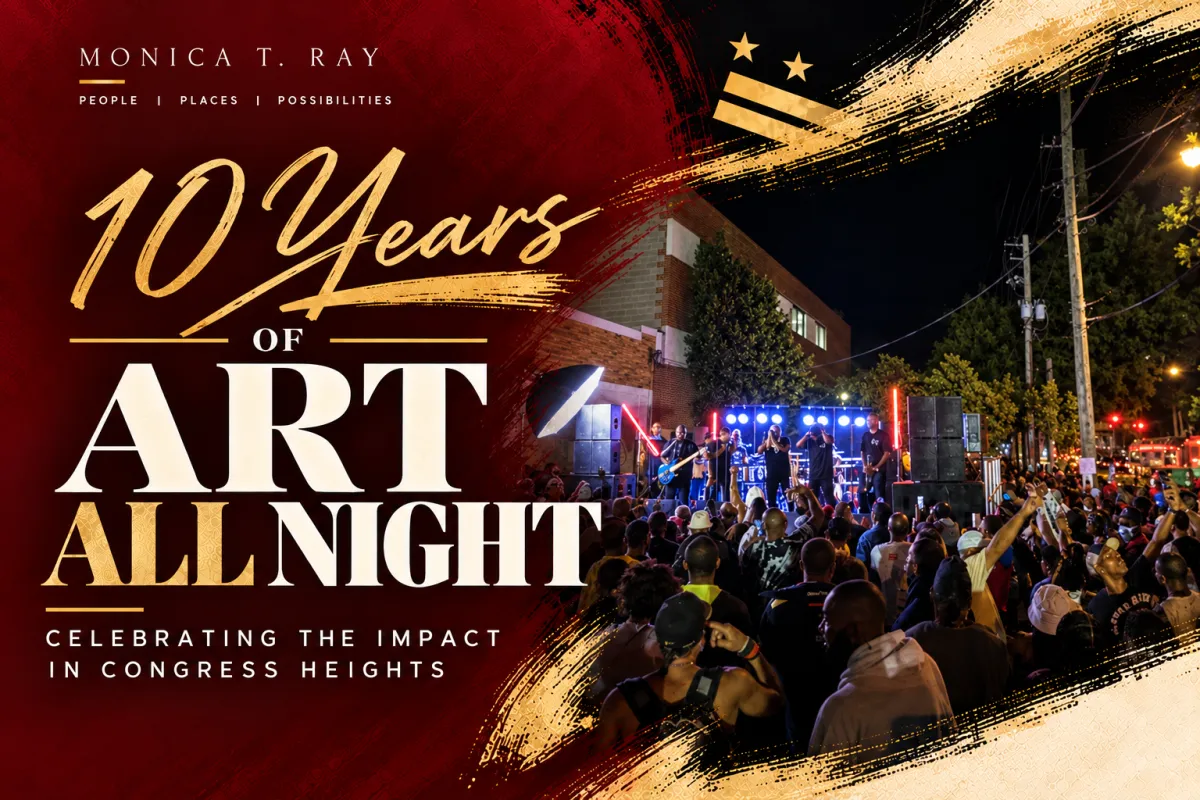
This year marks the 10th anniversary of Art All Night in Congress Heights, and when I think about what it took to get here, I do not just think about an arts festival.
I think about what happens when a community decides to use culture as an economic development strategy, a public safety strategy, and a declaration of place.
When Destination Congress Heights Main Street began bringing Art All Night to Ward 8 in 2016, we were a brand new Main Street program trying to convince people to come to Congress Heights. Some years, we were also convincing our own businesses that staying open late would be worth it.
From the beginning, the vision was bigger than producing an event. We wanted to integrate the arts directly into our commercial corridor, our neighborhood businesses, and the everyday experience of Congress Heights.
There were years when we subsidized businesses just to stay open.
There were years when attracting artists, vendors, sponsors, and visitors meant calling everybody we knew, and then calling them again.
We learned permits. We learned DPW requirements. We learned MPD requirements. We learned street closures, production, fundraising, logistics, partnerships, and all the other things nobody sees when the lights finally come on.
And along the way, we learned that sometimes placemaking begins with infrastructure.
We encouraged business owners to use our facade improvement dollars not only to beautify their storefronts, but also to install exterior lighting on their buildings.
We wanted to literally help light up Martin Luther King Jr. Avenue for Art All Night and for the other placemaking events we were building throughout the year.
That mattered.
Lighting made the corridor feel more active.
More welcoming.
More visible.
More connected.
It also meant that an investment made in preparation for one night could continue working for our businesses and our neighborhood long after Art All Night ended.
Then something else happened.
People came.
8,700 people in 2017.
11,000 people in 2018.
16,000 people in 2019.
14,500 people when we returned in person in 2021 after COVID forced us to go virtual in 2020.
That represents more than 50,000 documented visits in just those four years, with dozens of venues activated, hundreds of artists showcased, and hundreds of opportunities created for vendors and entrepreneurs.
And those people did not simply attend.
They spent money.
Our first impact study found that more than 600 local businesses had participated. Of those businesses, 96 percent were Black owned. A total of 444 participating founders and artists were women, and 63 percent of participating business owners were from Ward 8.
We were investing an average of approximately $70,000 each year directly into the creative economy.
Vendors reported average Art All Night sales of approximately $600 for makers and $3,200 for food and beverage businesses.
That is why I have always pushed back against the idea that arts and culture somehow exist separately from economic development.
Art All Night became business retention.
It became customer acquisition.
It became entrepreneurship.
It became corridor marketing.
It became a reason to cross the river, get off the train, walk MLK Avenue, and discover Congress Heights for yourself.
There was another kind of impact too.
For one night, thousands of people filled our sidewalks, businesses, stages, and public spaces well into the evening.
Families were outside.
Artists were performing.
Vendors were selling.
Businesses were operating.
Police, public works teams, volunteers, organizers, business owners, and community members were all coordinated around one shared environment.
The early numbers show just how intentional that infrastructure was. The Congress Heights production alone invested tens of thousands of dollars annually in MPD, DPW, permitting, and other requirements.
But the strategy was never only about city services.
It was also about creating the physical conditions for people to feel comfortable being in the corridor at night.
That is why those facade improvement dollars mattered.
Exterior lighting became part of the economic development strategy.
Part of the public safety strategy.
Part of the placemaking strategy.
We were asking business owners to invest in the avenue with us. We wanted them to help illuminate storefronts, sidewalks, and gathering spaces so that the corridor itself could become part of the experience.
This year, I want us to go even deeper and begin measuring what so many of us have witnessed firsthand.
The crime suppression power of positive activation.
Not simply more police.
More legitimate activity.
More people.
More light.
More commerce.
More eyes on the street.
More reasons for residents to occupy, enjoy, and take ownership of their own neighborhood.
Because public safety is also about what we choose to fill a place with.
Over the years, we went from wondering whether we could fill the corridor to running out of room for vendors.
We went from stretching a modest city grant as far as possible to learning how to leverage roughly $30,000 into productions valued at more than $100,000 annually.
We went from asking businesses to stay open to businesses planning ahead for the crowd.
We went from trying to create a destination on MLK Avenue to staging mass midnight brunches right in the middle of it, first at Old Congress Heights School and later at the St. Elizabeths Pavilion.
That evolution may be most visible in the businesses themselves.
This year, we get to celebrate Players Lounge and 54 years of holding space in Congress Heights.
That is a true legacy business. A business that has survived, adapted, and remained part of the cultural fabric of this community for more than half a century.
And right alongside that legacy, we get to welcome MoeBachi to its very first Art All Night.
That is the full circle.
A business that has been here for 54 years.
A business experiencing Art All Night for the first time.
And a festival designed to make room for both.
Because Art All Night has never been only about putting artists on stages.
It has been about taking the creative energy that already exists inside our businesses and bringing it outside.
We brought barbers out of their barbershops.
We brought hairstylists out of their salons.
We brought chefs out of their kitchens.
We brought makers, designers, dancers, musicians, and entrepreneurs onto the sidewalks and into the streets.
We took the talent that people might ordinarily experience one customer at a time behind a storefront door and turned the entire corridor into a stage.
Hair being cut outside.
Styles being created outside.
Food being served outside.
Music being played outside.
Businesses being discovered outside.
Community being built outside.
That is what placemaking looks like when the people who already make the place are at the center of it.
To the vendors who came once and then kept coming back, thank you.
To the artists who trusted a young Main Street program with their work before Congress Heights Art All Night became one of the nights people circled on their calendars, thank you.
To the sponsors, city agencies, production partners, businesses, volunteers, and community partners who have been with us year after year, and especially those who believed in this vision when there was far more vision than evidence, this anniversary belongs to you too.
Now I am ready for the next question.
What do the last five years of data tell us?
How many additional people have walked this corridor?
How many dollars have moved through local businesses?
How many entrepreneurs found new customers here?
How much private investment did public dollars help leverage?
What happened to crime and calls for service during Art All Night compared with an ordinary weekend?
How many people experienced Congress Heights differently because they first encountered us through art?
Our first five years proved that something important was happening.
The next five may show us just how powerful it has become.
Ten years later, Art All Night is no longer simply something we produce in Congress Heights. It is part of how Congress Heights tells the world who we are.
From 54 years at Players Lounge to MoeBachi's very first Art All Night.
From dark storefronts to a corridor we intentionally worked to light up.
From inside the shop to outside.
From a young Main Street program trying to attract a crowd to a corridor that now has to figure out where to put everybody.
That is a decade of culture becoming commerce, commerce becoming community, and community becoming legacy.
There is only one Congress Heights.
There is only one Soul of the City.
Happy 10th Anniversary, Congress Heights Art All Night.
We are just getting started.
#CongressHeightsArtAllNight #ArtAllNightDC #DestinationCongressHeights #CongressHeights #SoulOfTheCity