Before I Had the Words for It
Before I Had the Words for It
By Monica T. Ray
Every August 26, this country pauses to mark Women’s Equality Day, the anniversary of the 1920 certification of the 19th Amendment, which prohibited denying the right to vote on the basis of sex. Yet for many women, particularly Black women, the constitutional promise did not immediately translate into meaningful access to the ballot. This year, August 26, 2026, falls on a Wednesday and lands during our nation’s 250th anniversary year, a moment when we are all being asked to look back honestly at who has and has not had full access to the promise of this country.
For me, that reckoning started long before it had a national spotlight.
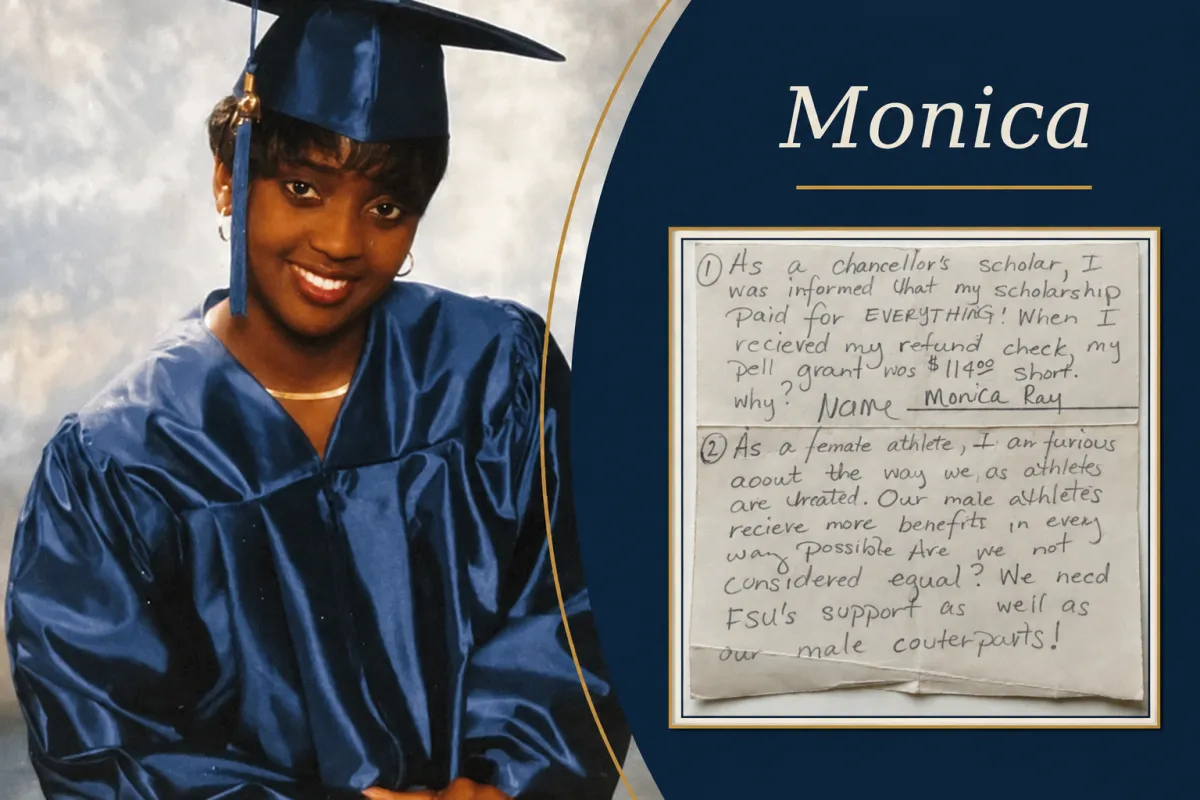
More than thirty years ago, as an undergraduate, I sat down and wrote two complaints on a folded sheet of notebook paper. I wasn’t writing a manifesto. I was a Chancellor’s Scholar who had just realized my Pell Grant refund check came up $114 short of what I had been promised. And I was a student athlete who was tired of watching my male counterparts receive more of everything, more resources, more attention, more support, while my teammates and I were told to make do with less.
Here, in my own handwriting, is what I wrote:
“As a chancellor’s scholar, I was informed that my scholarship paid for EVERYTHING! When I received my refund check, my Pell grant was $114.00 short. Why?”
“As a female athlete, I am furious about the way we, as athletes, are treated. Our male athletes receive more benefits in every way possible. Are we not considered equal? We need FSU’s support as well as our male counterparts!”
Reading those words today, it is striking how little translation those two paragraphs require. I was a young woman doing the math on what I had been promised versus what I actually received. I was a young woman asking, in plain language, why equal treatment on the field and in the locker room felt like a stretch goal instead of a baseline.
I wasn’t calling myself an advocate. I was simply asking “why,” out loud and on paper, which is where advocacy so often begins.
Three decades later, I am still asking that question, just with a much bigger platform from which to ask it. The work I do now, building a student pipeline between CC Prep and FSU, mentoring the next generation of scholars, launching the Entrepreneurship Flight Lab™ to give people the tools and language to build something of their own, developing Black women leaders through the Kiongozi Leadership Collective, and helping Black women entrepreneurs move from aspiration to ownership, scale, and generational wealth through the BlackBone Project, is the grown up, systems level version of that handwritten note.
I am no longer just flagging the gap. I am building the infrastructure, networks, and pathways needed to close it for the women and students coming behind me.
What the Gap Looks Like Today
The two complaints I wrote in college, translated into 2026 terms, are still very much live issues, including right here in Washington, D.C.
The financial aid math still doesn’t fully add up for women. Nationally, women who work full time, year round were paid just 81 cents for every dollar men earned in 2024, the most recent full year of Census data available. It was the second year in a row that the gap widened, representing the sharpest decline in wage equity in nearly six decades. That works out to a median of approximately $13,570 less per year for a woman doing the same kind of work.
In D.C. specifically, the picture is a little different. Women here earned about 84 cents on the dollar in 2025 by one weekly earnings measure. Looking at annual earnings using the most current Census data available from 2024, D.C.’s gap is approximately 13.9%, or roughly $13,660 a year. That is actually a slight improvement from the nearly $15,500 gap D.C. women faced just one year earlier.
Real progress, but still real money left on the table every year.
D.C. women are also proof of what is possible when access is available. Nationally, 40.1% of women held a bachelor’s degree or higher as of 2024. D.C. overall, men and women combined, has the highest rate of any state or territory in the country, at 65.5%. That access to education is a significant part of why D.C. continues to appear at the top of these lists.
D.C. women are also starting businesses at a rate well above the national average. Approximately 47% of D.C. businesses are women owned, according to the District’s Department of Small and Local Business Development. Nationally, that figure is closer to 40.6% as of this year, a number that has been climbing steadily but still trails D.C.
But business formation alone is not equality. Women, particularly Black women, must also have access to capital, contracts, trusted networks, technical assistance, and the tools required to grow beyond self employment. That is the work at the heart of the BlackBone Project: creating an ecosystem of accountability and sistership where Black women can build stronger businesses, scale their ideas, and turn today’s lessons into tomorrow’s legacies.
And the athletics gap I called out in that note? It is still real. Men’s Division I athletic programs continue to receive more than double the resources of women’s programs overall, with funding gaps for recruiting and coaching pay running close to three to one. A study published in the Journal of Sport Management as recently as October 2025 found that spending gaps between men’s and women’s basketball programs have actually regressed in some cases rather than improved.
And in the new NIL era, more than 60% of endorsement money is still flowing to football, men’s basketball, and baseball. Female athletes continue to earn a fraction of what their male counterparts receive, almost exactly echoing the frustration I put on paper in college in 1991.
The Throughline
What I hope people take from this is not simply that I was right thirty five years ago. It is that I did not stop at being right.
I turned a folded note of frustration into a career built around opening doors for other people: for students navigating financial aid and college access; for aspiring entrepreneurs who need a roadmap; for Black women through Kiongozi who need spaces to sharpen their leadership, expand their influence, and lead without shrinking themselves; for BlackBone entrepreneurs building businesses that can sustain families and create generational wealth; and for communities that need someone willing to keep asking, “Why not?”
Women’s Equality Day is not just about a constitutional amendment certified in 1920. It is about every version of the note I wrote, every young woman who does the math, notices the gap, and asks the question.
And it is about what becomes possible when she refuses to stop asking and turns that question into her life’s work.