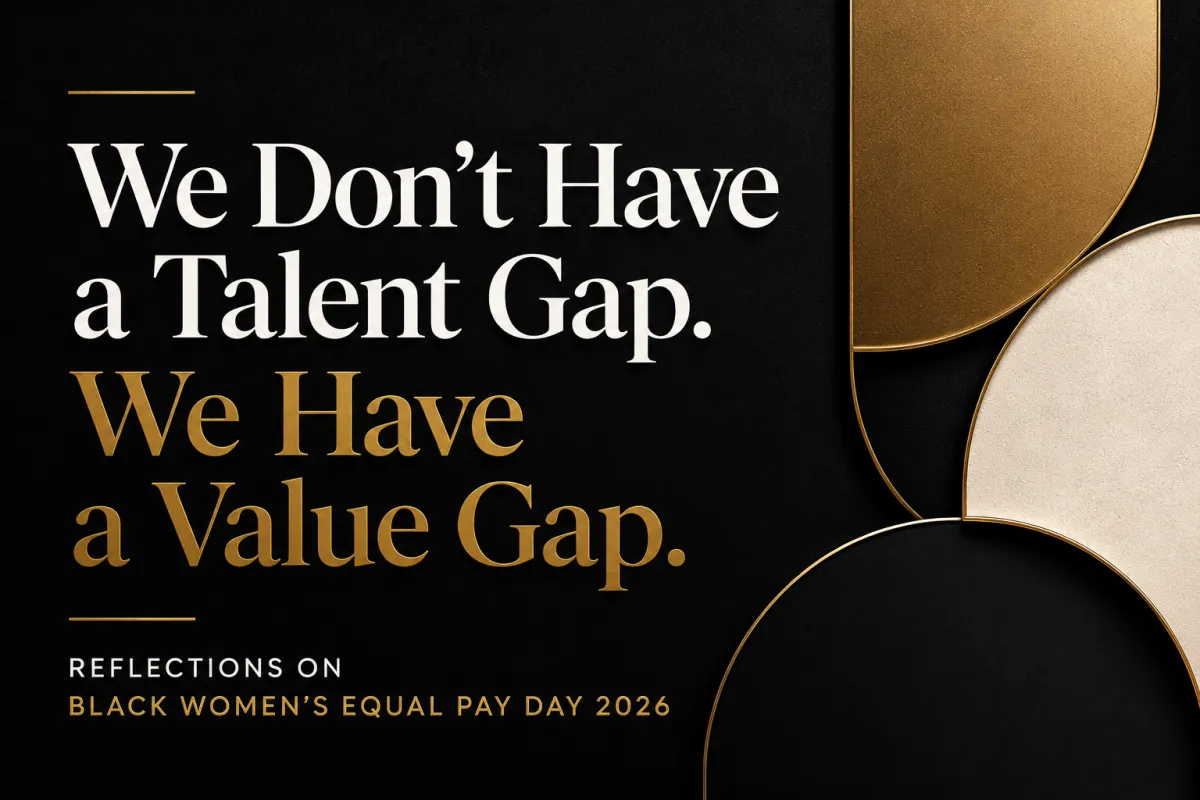
We Don't Have a Talent Gap. We Have a Value Gap.
Reflections on Black Women's Equal Pay Day 2026
By Monica T. Ray
July 21 marks Black Women's Equal Pay Day — the point in the calendar when Black women have finally earned what many white, non-Hispanic men earned by December 31 of the previous year.
Every year, we talk about the wage gap.
This year, I want to talk about something bigger: the Opportunity Gap.
Because for Black women, unequal pay is rarely the result of unequal ambition or unequal preparation. One of the greatest paradoxes in America is that Black women have become one of its most educated and entrepreneurial populations, yet continue to face some of the widest disparities in earnings and wealth.
We are earning college degrees at record rates. We are launching businesses faster than nearly any other demographic. We lead nonprofits, educate our children, care for our families, drive innovation, and anchor our communities.
And still, the economic return on our education, experience, and leadership continues to lag behind.
That is not simply a labor market issue. It is a wealth-building issue. A community development issue. An economic competitiveness issue.
Less Becomes Less
When Black women earn less, they invest less — not by choice, but because there are fewer dollars available to invest.
Less retirement. Less home equity. Less capital to start a business. Less inheritance for the next generation. Less opportunity for our children.
And because wealth compounds, so does inequality.
Every year a Black woman is underpaid relative to her peers, the gap widens. The missed retirement contribution never earns interest. The home purchase happens later, or not at all. The business expansion is delayed. The portfolio grows more slowly. The cushion gets thinner.
What begins as a wage gap becomes, over a lifetime, a wealth gap — one that spans generations.
That is why Equal Pay Day cannot simply be about salaries. It has to be about the systems that create pathways to economic mobility.
Building the Pathways
Throughout my career, that has been the work.
Through Community College Preparatory Academy, we serve adults who have been overlooked by traditional educational systems. Earning a diploma is only the beginning — it unlocks careers, increases earning potential, and creates economic mobility for people who deserve a second opportunity. Every credential earned is another door opened.
Through The BlackBone Project, I have watched hundreds of extraordinary Black women do what we have always done: support one another, mentor one another, celebrate one another, and build opportunities where none existed before. BlackBone was never meant to be just another networking group. It is an ecosystem of leadership, sisterhood, visibility, and economic empowerment — because success should never be a solitary journey.
And now, through the Soul of the City Business Improvement District, we are taking that work to the neighborhood level.
Economic justice isn't only won in boardrooms. It's built on commercial corridors. It's built when Black women-owned businesses open their doors. It's built when entrepreneurs have access to customers, capital, technical assistance, safe streets, clean public spaces, and thriving business districts. It's built when opportunity is visible on every block.
That is why equitable, place-based development matters. When we intentionally invest in communities that have historically been overlooked, we create environments where talent can flourish, businesses can grow, families can build wealth, and the next generation can imagine futures that once seemed impossible.
This work has never been about charity. It has always been about investment — in people, in place, in potential.
The Power of Potential
I believe in the Power of Potential, because I have seen what happens when someone believes in a person before the rest of the world does.
I have watched adults earn their first diploma after decades of believing it was too late.
I have watched Black women turn ideas into thriving businesses.
I have watched forgotten neighborhoods become places of possibility.
I have watched communities once defined by what they lacked become recognized for what they contribute.
That is what equal pay ultimately represents — not simply equal compensation for equal work, but equal recognition of equal value.
The Challenge
So today, I challenge employers to examine their compensation practices with honesty.
I challenge institutions to invest in leadership pipelines that reflect the talent already in the room.
I challenge investors to see Black women not as risks to manage, but as opportunities to fuel.
And I challenge each of us to keep building ecosystems where Black women are not merely invited to participate in prosperity, but empowered to create it.
Because when Black women prosper — families prosper, businesses prosper, neighborhoods prosper, cities prosper, America prospers.
The goal is not simply to close a wage gap. The goal is to unlock generations of unrealized potential.
That is work worth doing. And I intend to keep doing it.
Building Power. Building Place. Building Possibility.