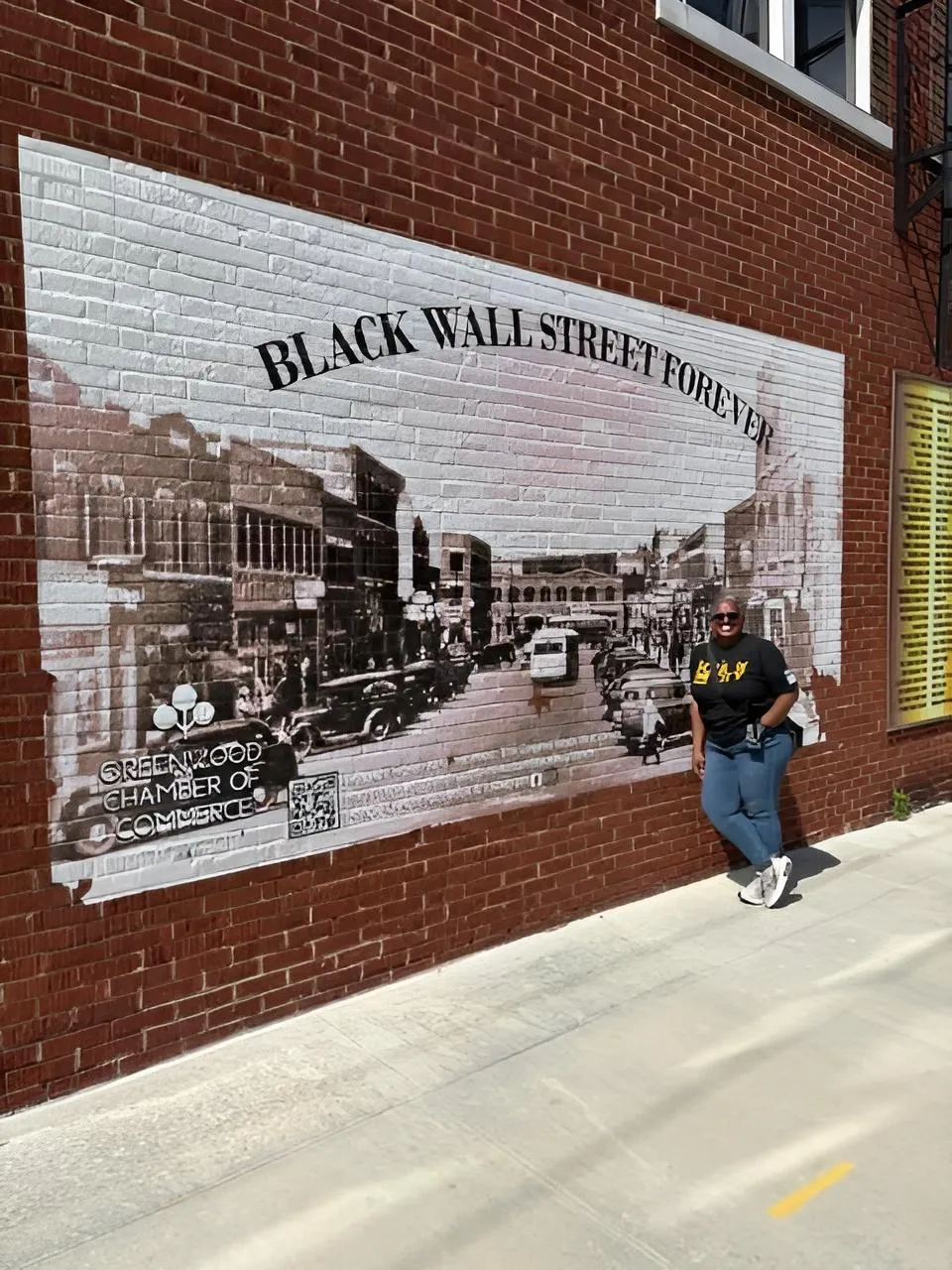
Black Wall Street Was Not Lost. It Was Interrupted.
There is a tendency, when we talk about Tulsa, to speak in past tense.
What was built.
What was destroyed.
What was lost.
But after walking the streets of the Greenwood District and sitting with the truth inside the Greenwood Rising Black Wall Street History Center, I am clear about one thing:
Black Wall Street was not lost. It was interrupted.
And the difference between those two words—lost and interrupted—is where the real work begins.
What Greenwood Actually Was: An Economic Engine
Greenwood was not simply a neighborhood. It was not just a symbol of Black excellence. It was an economic system.
A functioning, self-sustaining, wealth-generating ecosystem where:
Black doctors, lawyers, and entrepreneurs circulated dollars within their own community
Businesses lined the streets in dense, intentional proximity
Ownership was not aspirational—it was standard
This was not accidental. It was design
In today’s language, we would call Greenwood:
a concentrated commercial corridor
a culturally anchored business district
a localized model of economic sovereignty
But more than that, it was proof.
Proof that Black wealth—when allowed to organize, concentrate, and circulate—can scale.
What Was Destroyed: More Than Buildings
In 1921, violence didn’t just burn structures. It disrupted a system.
We often measure the Tulsa Race Massacre in acres destroyed or buildings lost. But that framing is incomplete.
What was actually taken was:
Economic momentum — generations of wealth-building halted in a single moment
Network density — relationships between business owners, customers, and institutions fractured
Psychological safety — the belief that what you build can endure
Destruction at that scale is not just physical—it is systemic.
And systems, once broken, do not simply restart.
They require intentional reconstruction.
What “Revitalization” Still Fails to Restore
Today, Greenwood is recognized. It is memorialized. It is visited.
But recognition is not restoration.
You can walk the district. You can read the history. You can stand in spaces that carry the weight of what once was.
But what you will not find—at scale—is the same density of Black-owned enterprise, the same circulation of capital, or the same ownership footprint that defined its original power.
And that is the gap.
Because too often, revitalization focuses on:
physical redevelopment
cultural storytelling
tourism-driven engagement
Without fully addressing:
who owns the land
who controls the capital
who benefits from the reinvestment
Commemoration without economic reconstruction creates a narrative—but not a future.
What Real Repair Would Require
If we are serious about honoring Greenwood—not just as history, but as a model—then we have to move beyond remembrance and into reconstruction.
Real repair is not symbolic. It is structural.
It requires three things:
1. Ownership
Not just participation. Not just presence.
Ownership of:
land
commercial corridors
development projects
Because ownership determines who benefits when value is created.
2. Capital
Not fragmented. Not episodic.
But aligned, patient, and intentional capital that:
supports Black entrepreneurs at scale
invests in ecosystem development, not just individual businesses
recognizes that rebuilding requires time and trust
3. Control
Control over narrative.
Control over development decisions.
Control over the future of place.
Because without control, even well-intentioned investment can replicate the very displacement it claims to address.
From Interruption to Continuation
Standing in Tulsa, what becomes clear is this:
Greenwood is not just a story about what happened in 1921.
It is a mirror
A mirror reflecting the ongoing tension between:
wealth creation and wealth extraction
development and displacement
memory and material change
And it asks a question of all of us doing place-based work:
Are we building systems that can sustain?
Or are we rebuilding stories without rebuilding structure?
The Work Ahead
Black Wall Street was never just about Tulsa.
It was—and still is—a blueprint.
Not for what was lost, but for what is possible when:
culture anchors community
capital is intentional
and ownership is non-negotiable
The work now is not to admire it.
The work is to continue it.
Because interruption does not mean ending.
It means there is still something left to build.
Closing Reflection
As I move through Tulsa and engage with leaders at the National Main Street Conference, one truth remains constant:
Place-based development that does not center ownership will always fall short of equity.
And if we are serious about equity, then we must be just as serious about rebuilding what was interrupted.